Florida painter, Everglades, Marco Island, artist Jo-Ann Sanborn

7/23/10

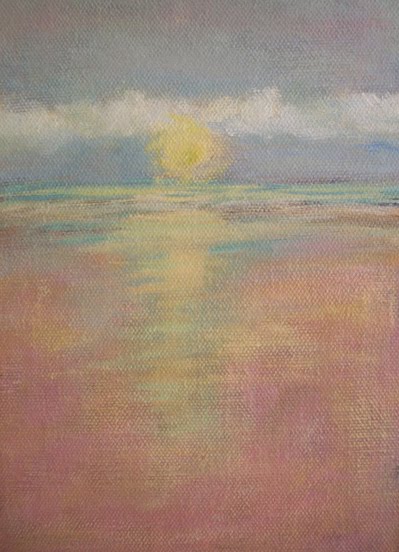
Mostly Yellow, 2010, Jo-Ann Sanborn
acrylic on board, 5"x7"

People ask me where a particular painting was painted. It's a great way to start a conversation about the piece. I'm happy to tell them. Most all of my paintings are painted of a particular location, one that I've visited and means something to me. As I'm searching for just the right feel for the painting I'm remembering the gentle trickle of the water or the whisper of the wind of the location to help me with it's interpretation.

If you're another artist, you might bring a critical or admiring eye to viewing a painting. You may want to look closely at color or form or composition, and see what you can learn, or how the work differs from what you do.

As a collector, you bring a sense of personal knowledge to the viewing. You might bring your wishes, your dreams and your memories. Perhaps the piece reminds you of a place you knew and loved as a child. Perhaps it looks like somewhere you walked with a friend, met a lover, or had a personal Epiphany.

Perhaps the depth of the work appeals to you. Maybe the colors are ones you and want to surround yourself with. Maybe the forms energize you or the peaceful flow of the water brings you peace.

Bringing together of the idea of the artist and the soul of the viewer that makes art worth doing! What do you bring to the viewing of a painting?

7/20/10

Messing around with Materials, by Everglades artist JoAnn Sanborn

Bananas
acrylic on board, 5"x5"

I almost always start with a dark background on my paintings. I like the cohesiveness that a solid background color brings to a painting, and I like being able to change things around easily at the start of a painting. Loosely moving around a canvas in that big dark trying to find my way using both years of study and intuitiveness is what makes my paintings uniquely mine. And working towards the light is a symbolism that appeals to me.

Still, messing around times are important, and there are times when working out of the norm is necessary. I had purchased some 5x5 cradled panels a while ago, and wanted to use them in a way different from my usual methods. They've been sitting there just waiting for the right idea to come along.

I've started a commission that I plan to use pen and ink as part of my mixed media plan, and it's been stirring around in the back of my mind. These little panels seemed like the perfect way to get more comfortable with pen and ink, which I haven't used for a good many years.

Messing around with materials can be both fun and rewarding. Using the simple banana leaves outside my window, I did a pen and ink drawing on the surface, and used transparent acrylics with quite a bit of medium to color the image.

It was fun and I learned a lot about where to go next to get the look I want for the commission, and maybe a way to go with the rest of the panels. How about taking a jaunt outside your comfort zone today?

7/16/10

Oil, Catching the Light painting by Everglades artist JoAnn Sanborn

Catching the Light
acrylic on canvas, 40x30

There's a first ray of hope that the gushing oil spill has been stopped after 87 days of flowing freely. Now begins the serious and difficult fight to save the Gulf of Mexico. Who will take the lead?

Cleaning up the Gulf, and restoring both the jobs and the habitat should now become the priority and focus of action. It will take teamwork, money, and leaderships to restore the loss of the marsh habitat in the upper Gulf, and remove the carpet of oil covering the Gulf bottom.

Someone needs to assess the effects of the oil and chemical dispersant on the vast number of species who's survivial depends on clean water and the the long-term effects on the human population who ring the Gulf, and generate a plan for their recovery.

Further south, the unique Everglades landscape I paint daily is so far unaffected. Our marshes are clear of oil and our beaches still lovely. I've spent long hours in the uninhabited places of South Florida, and come to love the sound of the wetlands and the singing of the insects and the birds as they go about their daily business in a world we can only imagine. I don't want to lose them.

7/14/10

Art League Sale, Just One daily painting by Everglades artist JoAnn Sanborn

Just One
acrylic on board, 6"x6"

My paintings seemed to be quiet and subdued for a while and now things are heating up with the warmer colors on my palette getting a work out. Is it the heat?

I respond to each Everglades landscape individually, and can't always be sure where even a small painting will take me, but I am enjoying the slower summer pace and the warmer colors. Today? Who knows. We'll see what my muse brings to the table.

One thing I'm planning this week is to stop by the Art League of Marco for their special sale. They've cleaned out the closets and are having a Rediscovered Treasure Trove of goods for sale. In addition to a wide range of 2 and 3-D work for sale, they'll be demonstrations centered around restoring and rejuvenating your older treasures. Should be fun, and I know they can use the money. If you're around I hope you'll help support this effort or stop in and enjoy one or more of the demonstrations. More information here.

7/12/10

Gulf Breeze
Acrylic on canvas, 24"x36

Despite the heat there's almost always a nice breeze here on Marco Island. The swaying of the palm trees and the movement of the grasses in the Everglades is delightful. The heat and the breeze are the inspiration for this new larger painting.

Some Ridley turtles have been released into the warm gulf waters south of Marco Island after spending some time in recoup after various injuries at the for Marine Mammal Studies in Gulfport, MS.

The turtles were moved to Sea World's Animal Rehabilitation Center in Orlando for rehab and released near Marco Island because the Oil Spill would have affected their safe release. The release was made possible by a cooperative effort between Center and Florida's Department of Fish and Wildlife.

Kemps Ridley Sea Turtles spend most of their life swimming long distance in both the Gulf and the Ocean. They're endangered in all of their habitat, and the oil spill will put further stress on the endangered species. Since Marco Island has only a very small chance of ever being affected, our waters should remain clear of the toxins associated with the spill. It is hoped that the turtles will remain in the area rather than try to return to their former home.

The Marco Island Foundation for the Arts was instrumental in the acquisition of a beautiful bronze sculpture of Kemps Ridley Sea Turtles by wildlife artist Kent Ullberg. The sculpture was donated to the City, and Journey's End can be seen at Jane Hitler Park, N.Collier Blvd, Marco Island. Stop by, it is lovely. And wish the released little turtles a safe journey.

7/9/10

Happy! Summer Sunset daily painting by Everglades artist JoAnn Sanborn

Marco Summer Sunset
acrylic on board, 5"x7"

I had a nice compliment last week when one of my collectors made a purchase. He said, "Your paintings make us happy." That's the type of comment I will hold in my heart and will help to offset the less complimentary comments I hear from time to time.

I'll remember it when a painting is not going quite as well as expected, I'm frustrated by not being able to get something quite right, or the feeling of the atmosphere just won't translate onto the canvas in the way I want.

It's right up there with the person who told me that "Your painting transformed our room!" Another art-sustaining compliment was when someone told me that "I didn't see the beauty of the Everglades until your paintings opened my eyes!"

Happy! What an gift from a collector, to be told that my paintings make them happy. Their purchase and that great compliment have made me happy for days! Thank you!

7/7/10

What makes a Professional Artist? Morning in Rose, daily painting by Everglades Artist Jo-Ann Sanborn

Morning in Rose
acyclic on canvas, 8"x10"

I've been thinking about what makes an artist a professional? The requirements aren't exactly like other professions--there's no State or Federal exam to qualify you, and a degree is only one way to get there. So, here's a start on my list. What do you think? If you're a collector, do you look for these things or rely on a gallery to qualify an artist for you? If you're an artist, how do you know you've arrived?

Education, which can take many forms, such as an art degree, apprenticeship, or working under an established artist, taking and learning in workshops, and extensive self study. A true artist is always learning something, and generally has a broader perspective on the world than many people.

Presentation, of a quality product using archival materials, preparing surfaces to last, honing skills the perseverance and practice over years of time. Learning, changing, growing.

Critical Acclaim, being accepted into juried exhibitions and museum shows, being asked to invitational events, winning prizes, being newsworthy, and developing a collector base who wants to purchase.

Acceptance to professional organizations, meeting their acceptance criteria, then being juried into state and national professional organizations.

Having an idea worth sharing, a unique style or palette, and wanting to convey something broader in each painting than just making a pretty picture.

7/5/10

Color Correction, Lazy River painting by Everglades artists JoAnn Sanborn

Lazy River
acrylic on canvas, 16x20

Lazy River is a rich, deep color painting of a spot down in the glades off Everglades City. I haven't been there for a while but remember the feeling of just floating along, enjoying the warm light on the palms and the slow movement of the current. Time almost stands still at moments like this. They bring a feeling of inner peace that's nice to remember.

I've purchased a small, light, mini-computer to leave in the studio or use when we have guests in the study. I'm not a gadget person, and this little mini comes close, but it does the job when I'm needing to look up something quickly or check emails.

Colors vary between one computer and another, but the color change between the mini-computer and my large monitor really surprised me. The background of the blog shows pink on the little guy, not the light yellow it should.

If the images you are receiving in your email don't look as rich and colorful as the paintings you have seen in my studio, or if the blog you are reading doesn't have a pale yellow background color, and you'd like to make color correction, learn here how to make simple color adjustments, or if you want more serious information, here.

7/2/10

Summertime, Out in the Glades, daily painting by Everglades Artist JoAnn Sanborn

Out in the Glades
acrylic on board, 5"x7"

Summer time on Marco Island gets pretty quiet without the fresh influx of visitors and guests, so the artists were delighted to have a great turn-out for the Art Walk last Wednesday. Congratulations to Tracy Gudgel who was this month's winner of the People's Choice. Artists Betty Newman and Tara O'Neill were tied close behind, only two votes separated them from the winner.

Although I paint almost every day, summer is a good time for me to really get my head behind my brush for some new work. It's a time when I experiment and learn. It's also a great time to paint large, since without so many people around, or shows to be dragging paintings to, there's a little more space to spread out, and have a nice triptych of Jane's Memorial Scenic Drive in mind.

It's my experience that the business of making fine art is as much in the head as in the brush. Both must work together for an artist. A thinking, learning, experimenting artist has a lot more to offer than someone who does the same thing over and over just because it's easy. Styles and techniques should expand and grow, and once you learn how to solve a particular art problem, it's time to move on.

So I'll be experimenting with new palettes, new colors, and new forms. And between the mosquitoes and the summer storms I'll go out into the Everglades again to see the way the light plays on the prairies and to absorb the essence of the landscape itself. Without connecting with my muse, the painting part just won't work at all.

6/30/10

Red, White and Blues, painting by Everglades artist JoAnn Sanborn

Red, White, and Blues
acrylic on canvas, 20"x24"


Red, White and Blues is the theme of the Artist Colony at the Esplanade's June Last Wednesday Art Walk to be held this Wednesday, June 30, from 5-8 p.m. Each of the three galleries will offer refreshments, music, and new art work for you to enjoy. We'll also be having our People's Choice Award, where you participate by voting on your three favorite pieces created for the theme Red, White and Blues. You can see mine, above.

While you are welcome to visit the galleries any Wednesday thru Saturday, visitors and residents alike are really enjoying the Last Wednesday Art Walks. The People Choice themed Art Walks are a lot of fun, and it's a chance to meet and talk with the artists about their work in an easy, relaxed atmosphere.

What do you talk with an artist about? With me, any talk of the Everglades is always welcome. I love hearing your stories about your visits there, and about your reaction paintings of my favorite landscape. You can also talk about any particular painting, such as theme, colors, and medium. To tell an artist what you feel when you look at a painting will also get a conversation started.

Art can make you laugh, cry, wonder, look more deeply at yourself or others. It adds depth and dimension to our community. So if you're on Marco Island, or close by, come along and join the conversation. I hope to see you tonight!

6/28/10

Mangroves, In the Stream painting by Everglades artist JoAnn Sanborn

In the Stream
acrylic on canvas, 16"x20"


This small mangrove plant is growing in an area near Marco Island where there's a bit of current, and when the tide rips water washes amoung the roots. I used a palette, or painting knife to add some texture and interest, but used a brush, too.

Most mangroves live on the edges of a stream, waterway, or river, and at the edges of the gulf where the water is a quiet backwash althougoh they can take root anywhere there's a bit of soil. Their multiple roots mitigate wave action and trap sediment.

Many animals find shelter either in the roots or branches of mangroves. The mangrove produces large amounts of organic detritus by shedding leaves, flowers and branches which provides food for a multitude of marine species such as snook, snapper, tarpon, jack, sheepshead, red drum, oysters, and shrimp. They also support a large insect population and serve as rookeries, for coastal birds such as brown pelicans, a variety of egrets and commerants, and the lovely roseate spoonbills.

The mangroves live in a salt environment, and can tolerate more salt in their tissues, often at levels that would kill other plants. Some of the sale is excluded at root level. It's believed that excess salt is stored in the older leaves which are then shed. Mangroves are protected by law as a valuable natural resource.

6/23/10

Sawgrass prairies, View of a Prairie painting by Everglades artist JoAnn Sanborn

View of a Prairie
Acrylic on canvas, 2x24

Near Marco Island, large areas of freshwater marl prairies border the deeper sloughs of the Everglades. The soils are made up almost entirely of dead plant materials and are extremely slow to decay, since they are submerged in water for the majority of the year. they contain soil that is more suited for slow seepage rather than full drainage.

This organic soil is know as peat, and can build up to a fifteen foot thick layer. The soil contains a lot of carbon, making it very fertile, but the lack of other nutrients make it difficult for plants to colonize.

A complex mixture of algae, bacteria, microbes, and detritus attaches itself to the surfaces of the submerged plants and is called periphyton. the periphyton forms the basis for a food chain since small fish and invertebrates feed on it and in turn provide food for the larger fish, which then provide food for the wading birds, and on up the food chain.

The sawgrass covering of the prairies is extremely efficient at utilizing available nutrients and flourishes in an environment lacking the nutrients of most growing areas. As phosphorous and other agricultural nutrients leach into the soil, cattails and other invasive plants are able to grow. While some of the prairies are meant to host a variety of species, we are losing large area of our native sawgrass prairies to cattails.

6/21/10

Florida Contemporary 2010 visit, Pair Bond by Everglades artist JoAnn Sanborn


Pair Bond
acrylic on board, 6"x6"

Friends, lovers, family, or spouse, two by the water always works.


I've been wanting to see the Naples Museum of Art's exhibition Florida contemporary 2010 before the Museum closes June 26 for another installation, so when an artist friend called to get together, we decided to make the Museum our first stop. the mission of the Museum is to inspire creativity and awaken curiosity, and the exhibition met both of these requirements.

The exhibition included the work of both established and emerging photographers, painters and sculptors, and included a number of mixed media pieces. The artists had to currently be residing in Florida, but many of them, and their images, were of somewhere else. The exhibit was not meant just to be a local statement.

I recognized the wonderfully depthful work Joann Lizio, and the graceful stone form of sculptor Angelica Kade right away, since both are friends and I admire their work. There were a couple of other artists represented that I knew, but the majority were new to me.

It was fun to view the show with another artists. Early on we decided that we would each pick a choice for best in show, and one we'd like to put on our own walls. This little exercise made us look more closely and thoughtfully at each piece. Some we admired the skill or loved the technique or idea, but wouldn't want to love with , others we'd love to live with, but probably wouldn't give "best in show

One of the most intriguing pieces was "Hand" by Billie Grace Lynn. Hung with fishing line from steel rodes, the bright red interactive hand would move creepily into yours as your hand went to shake it. Its remarkably lifelike movements both chilled and intrigued.

Art Critic Donald Miller wrote a wonderful piece about how this show develops. in the end, I picked a simple but extremely well-balanced abstract to live with, and a wonderfully rendered "Saint" as Best in Show. Since the Museum doesn't allow photos, you'll have to go and see for yourself what your favorites are!

6/18/10

Care and feeding of your Muse, Evening Song daily painting by Everglades artist JoAnn Sanborn

Evening Song
acrylic on board, 5"x7"

I spent a lovely hour in a garden by the water last evening, with a little breeze and a friend, restorative and peaceful. It got me thinking about the care and feeding of my muse, needing attention after last months computer woes.

My muse is the Everglades, that vast, wet, humid, green and very unique bit of our still lovely planet. The Everglades have a defined role in the health of our world. Rains come in the summer. Multiple, heavy, soaking rains that saturate the ground, fill the marshes, lakes, and sloughs, and cover the ground in a shallow moving river. The rain brings renewed life to the region, starting a cycle of life that nurtures the estuaries and beyond.

The rains feed the life forms that love both fresh and brackish water, like the fringes of mangroves lining the shoreline. Fish flourish in this mix, and the young feed protected among the roots of the mangroves fringes, and grow to provide food for many species, including humans. Both the Gulf of Mexico and the Atlantic Ocean benefit from this bounty of life.

As a muse, the Everglades wetlands and uplands provide me with endless artistic inspiration and exploration. On every visit I see something new and special. It may be the way the light hits a particular waterway, or the way a cloud teases the tops of the trees. Sometimes it's one of the elusive animals that delights me. My muse gives me a lot, and as a result, I want to do it justice.

To help sustain my muse, I've joined a few of the Everglades support groups. I've given donations of both paintings and financial support. In my studio I talk with people about the value of the land and often give visitors a map so they can go and see for themselves.

But most of all I painting the Everglades, almost exclusively. I paint them because exploring the strong forms, bold shapes and fantastic light interests me. My highest compliment is when someone tells me that I've opened their eyes to the beauty of the Everglades landscape. Whether working on site or in the studio, portraying my muse is a joy.

What's your muse, and how do you care for it?

6/16/10

Not computer woes, again?

Glorious Moment
Acrylic on Canvas. 5"x&"
Here I am once again complaining about trying to learn just enough technical literacy to keep in the race. I'm not young, started life without even a TV, and grew up kicking and screaming as I was pulled into new times. But, if you don't speak the language you'll be left behind, and I'm not one who likes to be left behind!


I received a new camera for Mother's Day. More pixels, more memory, more pleasure, right. Wrong! I can just barely take a photo and get it up on this blog. Took me nearly half an hour this morning just to find the right connection cord to get the photo from the camera to the computer. Still in the box. UGH


This camera tells me just before I shoot EVERY SINGLE PHOTO that my hands are shaking. I'm old, but not THAT old. I brace myself, hold my breath, tuck in my elbows, look for inner stillness, and nope, still too shaky. I give up, but then can't find the tripod.


I can probably edit it out. That would be if I didn't have a new computer. Because it's been so long and I've been delaying the purchase, every one of my old and reliable programs need to be updated, or are outdated. This mean they no longer work the way they did. Organizing now means something else. I can't find the files, and they're certainly not where they were in relation to each other. If I write my blog post elsewhere, it won't cut and paste in any more. I did have a lovely one ready, and where are my photos?


Because I use Carbonite, an on-line computer back up, I know they're there, and that's a relief. I'm gradually finding and restoring as time passes, but this is not a quick process--at least for me. Some things won't show up in the new programs, or the data is in a format not acceptable. It too me an entire week to find and restore my business account, but that, at last seems OK


Back to my photo. I could edit it with Photoshop. That is if I knew how to use Photoshop. It's new, and its on my computer, but it speaks a very different language from my old software editing program. I've got two huge books, but haven't read them yet since I'm still spending every spare minute restoring and recovering files.


Anyway, everyone knows how to use Photoshop, right? Not me. I should be able to figure this out, at least for one quick photo. Well, I give up for today. I took a photo with shaky hands, can't edit it, couldn't find the cord to put it in the computer, couldn't find the photo, couldn't move it into Photoshop, had trouble doing what I wanted with it, thought I had it until the wrong photo appeared above. It's obviously one of the unedited versions, taken with the shaky hands. I don't know why it has the label of the one I spend an hour figuring out how to edit.


You'll just have to stop in and see the little daily painting in person if you're on Marco. It's lovely, and I'll replace this photo just as soon as I can figure out how!


Meanwhile, I'm at wit's end over this. I'd call in a professional if I really thought it would help, but know that it's mostly about me learning new thing. Anyway, it's time to stop whining and go painting. Thanks for listening!

6/14/10

It's not a new toaster, March Morning painting by Everglades artist JoAnn Sanborn

Marsh Morning
acrylic on canvas, 20"x20"

We haven't had much rain yet but the mornings have been lovely, and visiting the marshes early in the morning is a joy. There's peace and beauty in this Everglades march. Still, sometimes there's something in your mind that won't let go, so here goes!

Marketing art in this economy is not easy, and many artists have discovered that a combination of gallery representation and self representation is the best way to manage art sales. Pricing is always a big issue, and get a group of artists together and the pricing conversation can go on for hours. the goal is to get a decent wage for your work and for your level of professionalism and training, and yet to remain competitive in the marketplace.

Most artists know to never, ever, to set the price of a work differently for particular venue, or in that case, for the look of someones shoes. The price set should be the price, no matter where the work is seen, although it may rise as time goes on. An example of this would be a limited edition sculpture, where pieces rise as less are available, or if you sell a similar piece at a higher price.

Professional artists also know that if a gallery collector happens to make a studio visit and to purchase, the gallery is due its commission. This works for both sides if the gallery has willingly shared the names of your collectors it has sold to as it should. It's also wise to have a policy in place for sales through designers and decorators, ensuring that the final piece a client pays will be the same as if they had dealt directly with the artist.

This is good business because it builds trust with others, who are then free to promote your work for compensation, and with clients, because the value of the work they purchase is solid. At the international level, prices paid for high-end art work has reached the ridiculous, but on the local level there's a lot of talk about discounting artwork because the economy has affected so many incomes.

To me, thoughtless discounting of artwork is a betrayal of the client who purchased equal work at a higher level. While it may serve to bring in immediate income in the long run the work is devalued. Still, it's important to reward those who are repeat collectors, and care about you and your work. Artwork is not like purchasing a new toaster, and shouldn't be treated as such.

When you tell me that you love my work and want one of my paintings, I want to help you to own it. If you don't have the means to make a large purchase, choose one of my smaller works to get started, or for something larger we can work out a payment plan that meets your needs. Then the sale will please both of us.

6/11/10

Oil & Wildlife, Clouds over the Glades daily painting by Everglades Artist JoAnn Sanborn

Clouds over the Glades
5"x7" acrylic on canvas

With the Gulf oil spill still not contained, the impact on wildlife is becoming critical. The Louisiana Gulf Coast region is home to more than forty percent--think of it, forty percent--of our nations valuable wetland habitat. More that 400 species are dependent on that area for food, protection and breeding

The spill threatens all manner of Gulf wildlife and even if stopped tomorrow, if they survive, these species will be impacted for decades. Having lived on Gulf waters for almost 20 years now, I can't imagine it without the rich bounty of sea life we so enjoy.

While BP made mistakes, big ones, and must pay, this event could have world-wide effect on our water and food supply. Nothing short of a monumental effort to stop and clean up the mess should be mounted. The full power of the United States People should be brought to bear--not to lay blame but to find solutions, to help the affected wildlife, to put to work those whose livelihood is on hold.

If the spill is stopped soon, there is some indication that by the time the oil reaches Marco Island and my beloved Everglades, it may be diluted or dispersed. Just in case, I'm glad that our County and City government are taking the threat seriously, watching closely, and taking an active role in preparing for impact.

The National Wildlife Federation is involved and has some suggestions for those of you who want to help with the sad situation of impacted wildlife. You can volunteer, donate, speak up, or share. Learn more here.

6/9/10

Complements, Composition, Learning Woes


I was fooling around with complimentary pairs the other day, wanting to refresh my eye. With just two colors to work with, and without having to worry about color choices, it serves to strengthen the value range in my work.

The first pair is blue and orange, the second yellow and purple, and the third is red and green. White is the only color added. I start out most paintings like this, blocking in the darks first and adding some light, and building my way to the details. I can do this first part fairly quickly, even on a large painting, and can see right away if the "balance" of the painting works.

If not, it's a quick and easy fix at this stage, much better than after hours of work you see that something is not quite right. Composition is the bones that the whole painting hangs on, and if it's not right, then all of the other principals of design just won't fall into place.

The reason that I'm showing you this today is that it is the only photo I can find easily. I've fallen head-long into the tar-pit of technology I spoke about a while ago. I've got a new computer and love it. My beloved son-in-law set it up, made sure I had email and could get to the Internet, and then the visit was over. Programs?

My problem. But I'm a smart woman, right? I can figure this out, right? So far, wrong, and all the while I'd rather be in the studio. All the programs I used easily were outdated, have to be found, upgraded, installed, and I have to learn to use them again. But I can do it, right?

Please bear with me. It's going to be a sticky few weeks until I'm back in my comfort zone.

6/7/10

Wet season, hurricane plans, and Waterway, painting by Everglades artist JoAnn Sanborn

Waterway
acrylic on canvas, 20x20
$800

The wet season of the Everglades started June 1, and we can expect a lot more rain than we've had in the last few months. Every day the storm clouds build over the Everglades, and at least in some places it's likely that rain will fall.

Rain is very important to the cycle of life in Southwest Florida. The rain fills the sloughs and sends much needed fresh water to the estuaries of the gulf. Cypress tree need and welcome the water. Orchids and swamp lilies of the Everglades will bloom and the sawgrass prairie will regenerate. The wildlife, centered around the waterholes during the dry season, will disperse, mate, and bear young.

Along with the life giving afternoon thunderstorms, sometimes we get hurricanes, the best rainmakers of all. They're very natural for this climate this time of year, and many of the early native tribes would go north in the summer, just like many of our snowbirds do to avoid the danger.

For those of us who chose to stay, it's time to make sure that you and your family have a Hurricane Plan. Stock up on the things you know you might need, and watch the weather a little more closely. Our environment can handle a hurricane. Be sure you can, too.

6/3/10

Oil Spill, Rainy Season, Watson Pond on the Grey Day painting by Everglades artist Jo-Ann Sanborn

Watson Pond on a Grey Day
acrylic on canvas, 20"x24,"

The rainy season has started here on Marco Island. Early in the day the gorgeous thunderheads begin to build and later will drop their load of life-giving rain onto the waiting landscape. Today we had a strong storm just before daybreak and the sky is lovely with pinks and purples.

Yet the threat of the Gulf oil spill continues, and the fact that the oil is still flowing freely is appalling and saddening. Although no oil has arrived here in South Florida yet, the ongoing threat is causing grave concern to anyone who loves our fragile environment.

The National Park service is closely monitoring the results of clean-up efforts in the northern Gulf, and making plans to protect visitors and responders. This week a national Incident Management Team has taken control of the parks and begun a baseline assessment of conditions, expected to finish this week.

Much of the Big Cypress National Preserve is inland, and probably will not be severely impacted, but the mangrove fringes of Everglades National Park that ring Southwest Florida are sure to be threatened. If you go to the Everglades link, look for the map and see how the Mangrove fringes follow the path of the Gulf Stream around the Florida peninsula. (sorry the link wouldn't copy)

These areas where shorebirds and dolphin flourish are remote, wild and lovely. There are no hotels, white sand beaches, or big money involved. These areas have been left to the plants and the animals, in a unique and special protected environment. It will be impossible to get in and remove the oil from in and around the multiple legs of a hundred thousand mangroves, or even the wings of a suffering shorebird far from where roads, and even boats can travel.

And still, no one in Government is telling us to conserve and limit our use of oil. BP and the Government won't let us help. No one is spreading hay and collecting oil on barges ahead of the oil as it approaches delicate areas. Why? You can follow the progress of the spill here.
Related Posts Plugin for WordPress, Blogger...